Unity Then and Now

1 Corinthians 12:12-31a
For just as the body is one and has many members, and all the members of the body, though many, are one body, so it is with Christ. For in the one Spirit we were all baptized into one body—Jews or Greeks, slaves or free—and we were all made to drink of one Spirit. Indeed, the body does not consist of one member but of many. If the foot would say, “Because I am not a hand, I do not belong to the body,” that would not make it any less a part of the body. And if the ear would say, “Because I am not an eye, I do not belong to the body,” that would not make it any less a part of the body. If the whole body were an eye, where would the hearing be? If the whole body were hearing, where would the sense of smell be? But as it is, God arranged the members in the body, each one of them, as he chose. If all were a single member, where would the body be? As it is, there are many members, yet one body. The eye cannot say to the hand, “I have no need of you,” nor again the head to the feet, “I have no need of you.” On the contrary, the members of the body that seem to be weaker are indispensable, and those members of the body that we think less honorable we clothe with greater honor, and our less respectable members are treated with greater respect; whereas our more respectable members do not need this. But God has so arranged the body, giving the greater honor to the inferior member, that there may be no dissension within the body, but the members may have the same care for one another. If one member suffers, all suffer together with it; if one member is honored, all rejoice together with it.

Now you are the body of Christ and individually members of it. And God has appointed in the church first apostles, second prophets, third teachers; then deeds of power, then gifts of healing, forms of assistance, forms of leadership, various kinds of tongues. Are all apostles? Are all prophets? Are all teachers? Do all work miracles? Do all possess gifts of healing? Do all speak in tongues? Do all interpret? But strive for the greater gifts.


We’re in the midst of and nearing the end of the Week of Prayer for Christian Unity, a yearly observance in which we turn our thoughts and prayers toward the unity of the Christian church.  There’s not usually much fanfare about it; you don’t see clips on the local news about it; there’s no big front-page story on our ever-decreasing newspapers; nobody came to your door to collect donations for it.  It’s a quiet celebration, but one worth noting, nonetheless. 

It’s especially worth noting by those of us in the Disciples of Christ, a denomination founded on the idea that the church is one and we are in unity, or should be striving toward it at the least.  It was just a little over 200 years ago that one of the founders of our denomination, Thomas Campbell, issued his Declaration and Address in which he made the bold declaration that we repeated in our Call to Worship: “The church of Christ upon the earth is essentially, intentionally, and constitutionally one.”

Now if you think that Thomas was coming out of some pie-in-the-sky, idealistic setting in which all the denominations of his day on the frontier of the United States were working happily together, you must remember that Thomas, as a Presbyterian minister, was brought up on charges because he served communion to the wrong Presbyterians.  Plus, he came from Ireland where Presbyterians alone were divided and carved up in a variety of sects and separate denominations.  Thomas did not make his statement casually or without ruffling some feathers.

So here we are 200 years later and things don’t really look that much different.  Someone seeking a church home has a wide variety of options from which to choose.  There are still various denominations, some of which one is hard-pressed to distinguish from another.  And there are plenty of non-denominational churches.  There are large churches and small ones.  We’re no closer to being that ephemeral “one” than Thomas Campbell and his lot were, are we?

Yet, we continue to hold weeks of prayer for Christian unity.  And talks among and between various denominations continue, not so much seeking organic union so much anymore but laying the important groundwork of trying to understand one another, trying to get a grasp on our differences as well as our similarities.

In the midst of all this confusion and yearning for unity, it sure would be nice if we could find something in scripture to speak to our situation, wouldn’t it?  It’s sure too bad that the early church was so unified and together in its mission and operations, isn’t it?  I mean, if only there was some dissension amongst those in the congregations that were spreading throughout the Middle East and Asian Minor all the way over to Rome.  But no, they were all happy and got along famously, right?

Well, no.  They argued and fought and picked sides as badly as we do, if not worse.  Sure there weren’t divisions that made you choose among three different types of Christian churches on any given street corner.  Cities had their Christian fellowship that was part of the greater whole but there weren’t options within cities.  But once you got inside those early churches, watch out!

We know this because Paul, the author of our letter to the church in Corinth, was working hard to set those Corinthians right.  Corinth was a wildly diverse city.  It was an important trading center, spanning an isthmus in what is modern-day Greece.  Ships were pulling up to either side of Corinth all the time bringing not only goods from around the world, but also foreign ideas and people.  It was diverse and that diversity ended up showing up in the Christian gathering there.

Nowadays, we’ve come to value diversity.  We come to appreciate that we are all different and not the same and that’s a good thing.  But with diversity comes challenges; with diversity comes the potential for misunderstandings and quarrels; with diversity comes work.  And clearly the church at Corinth was working through their diversity and on the misunderstandings that went along with it.  Much like we’re doing these days, except on denominational levels usually.  That’s not to say that individual congregations don’t have their disagreements and misunderstandings, goodness knows.

Paul compared the church to a body and pointed out that no one part of the body was more important than any other.  No part of the body has the right to say it’s the most important part.  Nor does a part have the right to say it’s not important.  And that’s an important distinction to pay attention to. 

No one has the right to claim superiority in the body.  But no one has the right, either, to say they’re not a worthy part of the body.  Too often we discount our own worth and think too little of ourselves.  But Paul doesn’t let us get away with that.  Paul says we’re all important.

Our diversity, be it in our own congregations or throughout the wider church, is an organic growing thing.  It’s not a melting pot, for sure, in which we lose our identity to the greater product, but neither is it a box of pebbles in which the relation between the individual components is loose or nonexistent.  No, we are not pebbles, but connected to one another.

As I prepared for this sermon, I read about a commentator’s mother who, decades after a car accident needed back surgery. It seems that the accident affected her leg and year after year she compensated for the injury to her leg so much so that her back needed repair.  What happens to one part of our body affects other parts, without a doubt.

Likewise when part of Christ’s body suffers, the whole body suffers.  When one part of this immense church, spread across our earth, is in pain, the pain is felt throughout the whole of it.  We cannot escape it.

I have been spending a good bit of time lately reading the blog, or online journal, of a pair of our Global Ministries missionaries who are in Haiti.  Somehow they are able to connect to the internet and have been writing of their experiences and thoughts of that earthquake ravaged country.  I am strangely drawn to them and their plight, as they seek alternate housing after the collapse of their home, as well as the care of orphans and hoping to hear from the students at the medical school where they teach.  The pain of Haiti has affected many of us.  Even though we are thousands of miles away, we feel that pain in our own way, knowing part of the body is suffering.

Yes, this is the Week of Prayer for Christian Unity, but it is a unity through and celebrating the diversity of the church.  From small pockets of Indonesian Christians to the mega-churches of this country, we are all part of the body that Christ claims as Christ’s own.  And we are called to be united with the other members of that body, united through our Christian call to service and love.

The end of this chapter from 1st Corinthians actually points us to the next chapter: “But strive for the greater gifts,” Paul writes and then goes on to say, “And I will show you a still more excellent way.”  Paul’s “still more excellent way” is his stirring chapter about love.  Certainly love is the sinews and tendons that connect us to the other parts of the body.

With Haiti on Our Minds

Dear Friends,

An odd thing happened the other day while Allen & I were shopping for the different parts of the kits for Church World Service to go to Haiti.

As we shopped to complete a baby kit, we found everything we needed at a store, including good old-fashioned cloth diapers, except we couldn’t find diaper pins.  When I asked an employee, we found out that they no longer sell diaper pins.

I wanted to press her on the logic behind selling cloth diapers but not diaper pins, but thought better of it since it certainly wasn’t her decision about what the store carries.  Fortunately, we found another store that did carry diaper pins and our kit was complete.

But for a moment, the plight of some family in Haiti rested on whether we in California could find diaper pins.  Church World Service is very specific about what is contained in their kits and without those pins there would be no kit.  If we hadn’t searched harder to find those pins, there would be no kit.  No baby clothes and blankets and other infant necessities for someone recovering from the rubble of an earthquake-shattered life.

And so it is.  Our actions affect the life of someone half a world away.  Most of the time it isn’t that stark a connection perhaps, but often it can be.  The choices I make at the supermarket…where I get my hair cut…whether I leave a light on or not…each of these actions and a myriad of others have the potential of greatly affecting the lives of people I don’t know and will likely never meet.

Sometimes the decisions are pretty clear in their effect.  Often times they are not.  We do what we do and never really think about it.

But that’s the whole idea of community; that’s the idea of connection.  And with God, through God, we are connected to all of creation, including our brothers and sisters who are digging out in a country I’ve never even been near.

We are connected to those hundreds and thousands of miles away.  We should make sure we act like it.


PS--If you'd like to read a great blog from Haiti, read this one from the Global Ministries Missionaries to Haiti: http://kimandpatrick.blogspot.com.

PPS--If you're interested in creating your own kit to send to Church World Service, here are the instructions on how to do so.

The Miracles We Don't See

John 2:1-11

Without a doubt, across our country today, in sermons much like this one, attention is turning to the fact that this is the Sunday prior to Rev. Dr. Martin Luther King, Jr. Day.  Martin Luther King was, undoubtedly, one of the prophets of the 20th century who, because of his prophecy, became a martyr to the cause of civil rights.  So it is appropriate, moreso than at other national holidays, to focus our thoughts on this great man of faith because he was a man of faith and a prophetic voice in our midst.

Of course, King is now on a pedestal, untouchable and unassailable.  He is honored even by those who, during his lifetime, turned a deaf ear at best or denounced and hated him at the worst.  Of course that hatred spawned fear and anger which is what impelled a bullet into him that April day.  They say that hindsight is 20/20 and that is true for many when it comes to our views of Rev. King.  What some considered wild prophecy and non-violent hysteria at the time, now is revered.  What was disparaged and feared is now accepted fact.

King stood for nonviolence in the quest for rights, fashioning the civil rights movement of the 60s on the work of Gandhi a few decades earlier in India.  I’m not an expert on King certainly and recall little about him from his lifetime, though I have vague memories of his assassination in Memphis in 1968.  Little about the civil rights movement filtered through to rural northeastern Pennsylvania when I was 11, it seems.  So I suppose I could be accused of that same 20/20 hindsight in this sermon.

But great efforts, I know, were made to discredit King during his ministry.  He was wanting too much, too fast, some said.  He was a radical, a communist, said others.  Even fellow clergy, usually white clergy, turned away from him and distanced themselves from his prophetic orations.

It’s amazing what we can look at from the distance of some 40 years and accept without any qualms that at the time we missed completely.  With history swirling all around us, it sometimes difficult to know what’s important and what’s not.

In the reading for today, Jesus performs his first public miracle, according to the gospel writer, John.  It’s an odd story, without a doubt.  Jesus is reluctant at first.  Anyone who has been a parent, in fact, anyone who has been an offspring, which I’d bet is most of us, knows the way these conversations go.  Mother or Father wants something and expresses that to son or daughter only to be rebuked.  “What are you asking me for?”  Jesus’ response to his Mother, “Woman, what concern is that to you and to me?” is so typical of something any offspring would say to their parent that it echoes easily across the centuries and halfway around the globe and sounds all too familiar, some form of it having escaped from our very own lips.  His next comment though is a bit more quixotic, “My hour has not yet come.”  We can imagine Mary, along with the rest of us, thinking “whatever” as she then busies herself giving instructions to the servants.  The water becomes wine, the marriage feast is saved, and the host comes out looking pretty good, serving his best wine, which he didn’t even know he had, last of all.

The interesting thing about this sign is that no one sees it happen, including us.  John gives no description of the actual miracle as it occurs.  We get no actions that Jesus makes.  He just tells the servants to fill some large stone jars used for the Jewish rite of purification with water and the next thing we all know they’re filled with wine.  We get nothing of what Jesus said or did to make this happen.  No one saw it … it just was.

How many miracles happen like that all around us?  However you define a miracle, isn’t it quite possible that they occur each and every day without our noticing?  Isn’t it feasible that miracles occur and we don’t realize it until later missing the actual event of the miracle, as all those party guests did, including the steward and host, when Jesus kept the party going with a few large jars of wine.

It’s that same thing of hindsight being 20/20.  We look back and wonder at the miracle that has occurred right under our noses.  We look back at the words of Martin Luther King, Jr. and wonder where we were; how did we miss that particular miracle while we now enjoy the fine wine of King’s rhetorics.  Dr. King’s devotion to nonviolence and his commitment to justice were miracles at the time.  Yet many missed those miracles happening right in front of them, choosing instead to be fearful and critical.  Many couldn’t see the water turning into fine wine right in front of them.  Their vision was clouded by prejudice, racism, anger, and hatred.

I do think that Dr. King would today ask us to look for the miracles happening all around us each and every day.  There are many who work tirelessly for justice and rights in this day and age.  Many are responding to disasters such as the earthquakes in Samoa and Haiti.  Many are giving of themselves to further God’s commonwealth here on earth.  These are modern day miracles and all around us are new prophets whose voices are ignored.

Watch for miracles each and every day.  Watch for the work that Dr. King started and the miracles he performed to continue to this very day. 

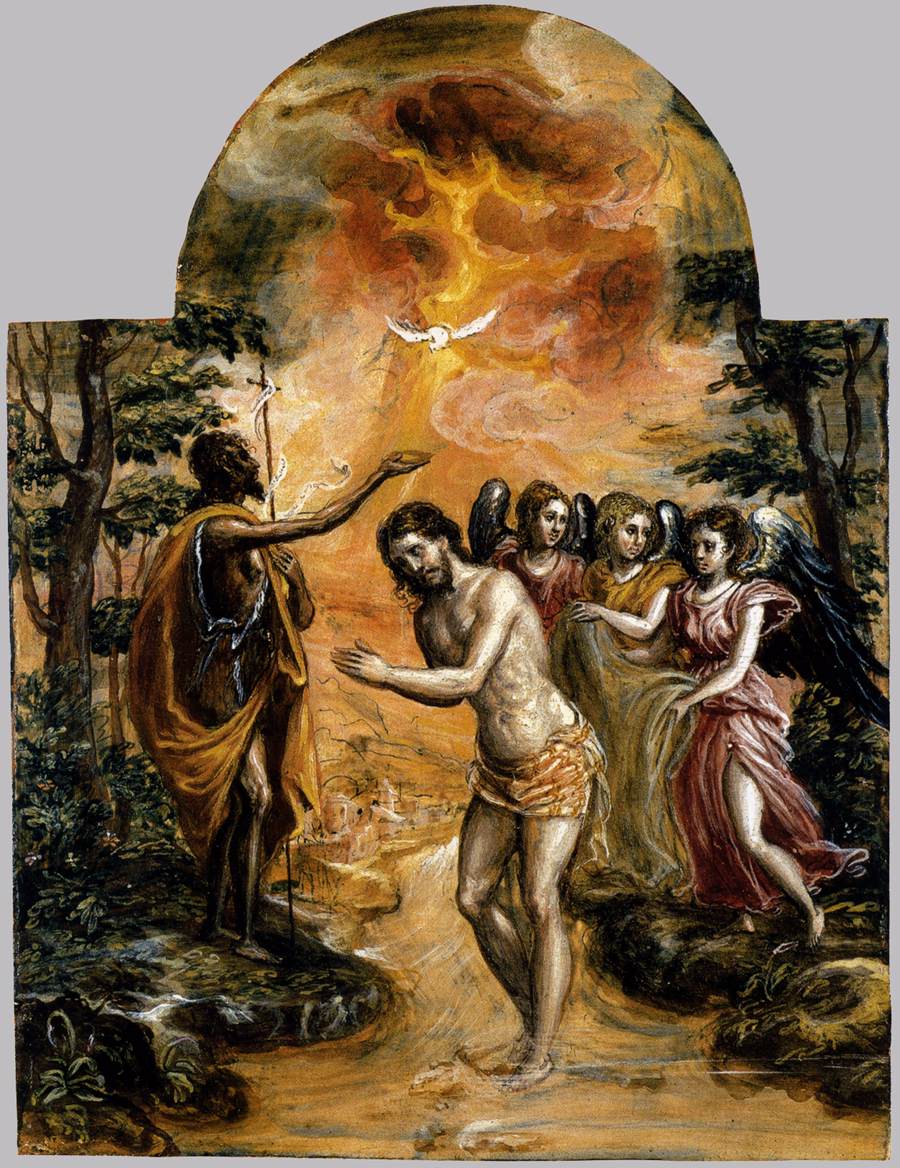
Elemental Baptism


Luke 3:15-17, 21-22

Martin Luther, the great reformer of the church, is known, among other things, for a few sayings:  “Here I stand, I can do no other” for instance.  And a favorite of mine: “If you sin, sin boldly” which gives me great license at times.  From watching the movie “Luther” during Advent, some of us learned that a theme in his life was a prayer he repeated: “I am yours. Save me.”

He is also said to have repeated the phrase “remember your baptism” to himself and his followers.  I don’t believe, since infant baptism was the standard at the time, that he was actually urging them to remember the moment they were baptized.  I think the essence of Luther’s phrase in this case is to remember that you are baptized; that you are already one of God’s beloved children.  You need do no more to earn any more grace or love or attention.  You are God’s already through your baptism.

Luther wrote, “A truly Christian life is nothing else than a daily baptism once begun and ever to be continued.” (http://www.ucc.org/worship/samuel/january-10-2010.html)  Luther wants us, and himself, to recognize that this is not a one time event.  We are to know constantly who we are and whose we are.  Baptism claims us as nothing else can or does.

The baptism of Jesus was very elemental--water, wind, & fire were all wrapped up in it.  And when you get those three together things are bound to happen.  The earth is shaped by water, wind, & fire.  It is carved and mutated by these strong forces.  And these are the exact forces that show up in our scripture this morning.

John said “I baptize you with water; but one who is more powerful than I...will baptize you with the Holy Spirit and fire.”  The Greek word for ‘spirit’ which is used here is pneuma, which can also be translated as wind.  

All this occurs at the end of the third chapter of Luke.  Luke takes three whole chapters and then some for us to get to the start of Jesus’ ministry.  Three chapters of angels appearing and not one but two special births and shepherds and children getting lost in the Temple and all sorts of events that the other gospel writers just ignore.

Three times prior to this point, Luke is telling someone to not be afraid.  “Do not be afraid” is heard by Zechariah (who is John’s father), Mary, and those shepherds.  Angels have a way of frightening people it seems, with good reason.  The sudden appearance of a heavenly being in one’s life would be fearful, at least it would be to me.  As frightening as water, wind, and fire.

We don’t need much in the way of reminders of the power of these elements:  Water pouring down a valley wreaking havoc in its wake;  Wind toppling buildings, bursting windows; Fire ravaging homes, homes of people and of animals, as well as everything else in its wake.  We only need to think of recent tsunamis, hurricanes, tornados, and wildfires to be reminded that we aren’t talking about a gentle, easygoing event here.

Baptism is elemental; it claims us at our very base.  And, if we forget the white outfits and happy receptions that follow, they are indeed frightening affairs; frightening not only for the ones being baptized, but also for the whole church.  We’re calling in the whole of creation to participate through water, wind, and fire when we perform a baptism.  And just as sure as those elements carve out the earth and reform it into another likeness, so too those who are baptized are carved out and reformed into a new being not to mention what happens to the church along the way.

Baptism isn’t about one person or even a small group of people.  Baptism is something that affects the whole of the church; all of Christianity is changed through a single, solitary baptism.

The early church performed its baptisms once a year at Easter.  Lent was a time of preparation for those who sought baptism. It was a time of learning and of being deprived of worldly comforts.  Those seeking baptism knew that they would face this frightening, awe-filling event but would do so with the church behind them.  Because the church was as intricately involved as they were.

Baptism, if you think about it, is a brush with death.  As one dips beneath water, one is cut off from the air that sustains life.  Below the water, there is no way that we humans can keep breathing.  Of course, most baptisms are a quick affair that in no way endangers the participants.  But to be immersed completely in water at the control of another is indeed a frightening prospect.

And it’s frightening for the whole church because without this individual’s brush with death, the church faces its own brush with death.  Without baptisms, there is no way that growth can happen.  It’s an irony: Near death brings growth. 

We come through this frightening, near-death event precisely because it is a blessing.  We are beloved and blessed through this process.  Isaiah had it right; God is with us through thundering water and raging fire.  Isaiah was preaching to an exiled Judah reminding them that whatever came, God was their God.  And it’s no accident that a few centuries later, a wild preacher out in the wilderness who was baptizing with water spoke of one who would do so with fire.  It’s because God will remember us through all of it and call us God’s own.

Blessed.  Beloved.  Baptism.  We are reminded of God’s great love for us as we enter the waters and fire, each and every day.  Luther’s continual, day after day baptism got it right; we are once and always baptized … we are once and always blessed … we are once and always beloved.

Water, wind, and fire: forces that constantly move and shape the world around us as they shape our very selves, our very beings.  The waters of your baptism still flow, all around and through you.  Whether you can recall that moment or not, remember your baptism each and every day.

Image is The Baptism of Christ by El Greco, 1568, found at the Web Gallery of Art.

Sermon, Sunday, 20 December 2009

Luke 1:39-45 & 46-55

If you look at the four gospels, you’ll notice that each of them has an account of John the Baptist baptizing Jesus as a central turning point in their accounts.  Mark starts his gospel out with this event without any prelude or lead up. 

If you read the other three gospels until that point, you get a mini-version of what is to come.  John’s prelude is other worldly in many ways:  The light shines in the darkness and the darkness did not overcome it.  (John 1:5 NRSV)  Matthew spends a lot of time fixing Jesus firmly within the Jewish tradition yet with an eye to speaking the gospel outside which are evidenced by his immediate listing of Jesus’ genealogy back to Abraham through David as well as the visit to the young savior Jesus by three mysterious, outsider Magi.  You know, as you read through Matthew, that he’s going to return to those themes of Jesus’ Jewishness and the spreading of the gospel outside.

But Luke, if you read his prologue, gives a very different story and is the only one to include the accounts we heard this morning of women, particularly of Mary and Elizabeth’s reunion and the extraordinary song that Mary sings as she comes to fully understand what is really going on.  Only Luke puts an emphasis on the women, silencing Elizabeth’s husband, Zachariah, and he keeps Joseph waiting in the wings for a few more verses.  Only Luke recounts Mary’s incredible song that is at once intensely personal as well as political to the extreme.  You know Luke’s gospel is going to be filled with good things.

Thus it is good for us to stop on this final Sunday before we reach Christmas and ponder with Mary and Elizabeth just what is happening.  This fourth Sunday in Advent when we’re almost but not quite there.  This final time of worship before the attention is all on a baby in a box of straw.  We stop for a breath in the frenetic pace that leads up to the 25th of December and listen to Elizabeth and Mary, almost touching heaven but remaining firmly planted here on earth.

First we have Elizabeth, surprised by her own pregnancy with a child who would grow up to be John the Baptist.  Both she and fetus John know something is up as soon as they hear Mary’s voice.  They don’t even have to see her; her voice is sufficient for them to start rejoicing about the approach, the advent if you will, of Mary and the particularly special treasure she is carrying.  With John leaping in the womb, Elizabeth has little choice but to greet Mary with words usually reserved for royalty and those who will bear royalty, which of course is what is going on. 

We’re not told why Mary decides to pay a visit to her kinswoman, Elizabeth, but something has drawn her there, perhaps inevitably; perhaps Mary herself doesn’t even know why she’s there.  Mary has already had her encounter with the angel Gabriel and is full of the knowledge that she’s been asked to perform a special duty and, more so, has accepted that duty.  Within, she knows, she is carrying one who is going to change all of history.  She knows this as only a mother can know it.

And that leads us to the second part of our scripture from Luke.  There, safe with Elizabeth, unfettered by having to act a certain way or do certain things as she would have to do back in Nazareth, she sings her heart out; singing as only an expectant mother can do about how her child is going to change everything and will turn the status quo upside down.

Dietrich Bonhoeffer writes about this singing that Mary does:

This song of Mary is the oldest Advent hymn.  It is at once the most passionate, the wildest, and one might even say, the most revolutionary Advent hymn ever sung.  This is not the gentle, tender, dreamy Mary whom we sometimes see in paintings; this is the passionate, surrendered, proud, enthusiastic Mary who speaks out here.  This song has none of the sweet, nostalgic, or even playful tones of some of our Christmas carols.  It is, instead, a hard, strong, inexorable song about collapsing thrones and humbled lords of this world, about the power and God and the powerlessness of humankind.  These are the tones of the women prophets of the Old Testament that now come to life in Mary’s mouth.  (The Mystery of Holy Night, p. 6)

And so, before we charge headlong into this event we call Christmas, before we stop in a chilly stable beneath a starry sky, before we sing the carols that we have sung for ages, we stop and consider the words that burst forth from a young, pregnant woman’s lips over two thousand years ago.  We consider how she saw the topsy-turvy world into which her child would be born and how he would bring into being his own topsy-turvy world and we realize that the song is song as strongly today as it ever has been.  The powerful still need to be brought down from their thrones and the lowly should be uplifted.  There are hungry ones in our midst who need their fill of good things while the proud could indeed use some scattering.

Mary’s song, sung out in safety in Elizabeth’s home echoes and echoes through the ages to us today.  It’s message is not diminished, indeed, if you listen closely enough, you will hear it just before you perceive the beating of angels’ wings.

Sermon, Sunday, 8 November 2009

Ruth 3:1-5, 4:13-17

The thin book of Ruth, only four chapters long, is only one of two books of the Bible with a woman’s name attached to it.  And it shows up in the lectionary only twice in the three-year cycle.  So it’s good, when she makes her appearance, to pay attention to this book.  The story of Ruth covers more than what we heard this morning.  So let me recap that story a bit.

Naomi and her husband and two sons move from Bethlehem to Moab, which is another country near to Israel.  There the sons marry Moabite women, Orpah & Ruth, and all seems well.  Until the worst of the worst happens: first Naomi’s husband dies followed by the death of both of the sons.  We aren’t told how or why these tragic events transpire, just that they do, leaving behind three widows.

Of course, to be a widow was about as low as you could get socio-economically.  The only thing worse would be to find yourself a widow without any sons, which was the situation in which Naomi, Orpah, & Ruth found themselves.  And to add to that, Naomi was a foreigner in Moab--a son-less, husband-less, foreign, woman.

Naomi makes the decision to return home, so she would at least be among her kin people.  At first, her two daughters-in-law follow her on the sad trek back to Bethlehem.  But Naomi stops and says, “Go home...go back to your people.  Make lives for yourselves there.  I have no more sons to offer you and there’s nothing for you with me.”  They argue a bit and eventually Orpah does decide to turn back and cast her fate among the Moabites, and there follows a tearful farewell. 

Ruth, however, is a different story.  She will not be budged; she insists on following Naomi.  She speaks those words to her mother-in-law that many of us have likely heard before: 
Where you go, I will go; Where you lodge, I will lodge; your people shall be my people, and your God my God.  Where you die, I will die--there will I be buried.  May the Lord do thus and so to me, and more as well, if even death parts me from you.  (Ruth 1:16b-17)
Naomi sees how determined Ruth is and gives up trying to convince her otherwise.  So the two women continue their journey on the dusty road to Bethlehem.

So we have Naomi and Ruth back in Bethlehem, still without husbands or sons.  Naturally, the life of a poor woman was as difficult then as it is now, if not even more so.  She had to work from dawn to dusk just to survive.  And one of the ways that you could survive was by gleaning.

In the painting on your bulletin covers and now on the screen, the painter Nicholas Poisson shows Ruth meeting Boaz, a kinsman of Naomi who notices Ruth from the very first time.   Ruth is an outsider; only a member of the clan because of her persistent attachment to Naomi. 

Gleaning was a way that poor people could get grain to make bread for their survival.  After reapers went through a field with their sickles bundling the sheaves of grain as they went, they naturally would miss some of the grain, which fell to the earth.  Gleaners would come after them and pick up the pieces they missed for their own use.  There were laws that allowed people like Ruth to glean and prohibited the landowner from going back to pick up what was missed.


There is a famous painting in the Orsay Museum by Jean-François Millet, painted around the time that Poisson painted his painting, called “The Gleaners.”  It’s one of my favorite paintings and a print of it hangs in our apartment.  Something about that painting speaks to me.  As you can see, gleaning is back-breaking work.  Gleaners had to bend over in the stubble that was left behind to find what they could.  This painting shows some of that and one can imagine Ruth there, picking through what was left behind to feed herself and Naomi.

This is where today’s story picks up.  As I said, Boaz has already noticed the Moabite outsider named Ruth and knows of her connection to his kinswoman, Naomi.  This is important, because the laws of inheritance required that a dead man’s property would go to his next-of-kin; property was not only land but widows and any other dependent relatives.  The trick is that even though Boaz has obviously taken a shine to Ruth and Ruth, with Naomi’s help and advice as we heard in the first part of today’s reading, works to get into Boaz’s heart; but even though Boaz is a kinsman, he’s not the next-of-kin.  That’s someone else and Boaz very cleverly get this other kinsman to give up his right to Naomi’s husband’s property and that Maobite woman.  Which nicely leaves Boaz able to take Ruth as his wife.  And we all heard how Ruth then gives birth to a son and, in the process, Naomi is taken care of.  A true rags to riches story.  Happy ending, curtain down.

Except I’m going to fast-forward us a few centuries to the point in time of the books of Ezra & Nehemiah.  Ezra & Nehemiah are from the period of the return of the exiles from Babylon.  As you probably remember, Judah was overrun by the Babylonians, Jerusalem and the Temple were destroyed, and many of the people of Judah were taken into exile into Babylon.  There they remained several decades--long enough for another generation to be born, a generation that had never seen the glory of the Temple and had never set foot in Jerusalem.  This generation grew up in Babylon, learning its language and in some cases taking spouses from the Babylonian population.

Upon their release and subsequent return to Jerusalem, a faction appeared that wanted to purify the people.  They wanted to rid themselves of foreign influences, including these outside wives.  Ezra and Nehemiah are about these attempts, including the rebuilding of the Temple from the ruins of that once noble city.  They were attempting to step backward in time.  As we all know, when looking back, things are always better, as we put on our rosy-colored glasses for our hindsight vision.  It was no different then then it is now.

The leaders at the time of Ezra & Nehemiah sought to cleanse their society and purge out all elements that didn’t seem like it fit with their ideal world.  Except this tale of Ruth, the Moabite woman, comes onto the scene.  Ruth, who not only is a foreigner who marries into the Jews, but is also the mother of a long, important line of Jewish leaders.  That’s why that final line in today’s reading is so important:  They named him Obed; he became the father of Jesse, the father of David.

David, you probably realize, is none other than King David, the best and most revered ruler that Israel had ever known.  Yes, David’s, King David’s, great-grandmother was a Moabite, the worst foreigner you could think of.  By recounting this tale during the time of Ezra & Nehemiah, somebody was saying “Not so fast with this attempt at purity.  Remember our history.  Remember our past when God intervened through a foreign woman and we got David out of it.”


The story of Ruth and its subsequent use years later does sound somewhat familiar, at least it does to me.  For example, we hear cries about immigrants from far and wide; how they’re taking over and changing our culture; how they’re taking jobs away from hard-working Americans.  Yet, we put on those rose-colored glasses when we look back and miss the fact, somehow, that all of us, unless we have Native American blood in us, came from immigrant stock at one point or other.  We forget that the Irish and Italians and Chinese and those from many other lands all suffered when they first come to this country because they were immigrants.  And we’ll leave aside for the time being the forced immigration of countless Africans before the slave trade ended.  But we forget that immigration has always been with us, as we put on those rosy-colored glasses and look back smilingly.

Those rosy-colored glasses, however they’re used for hindsight viewing, will always get you into trouble.  It’s as true now as it was during the era when the exiles returned from Babylon.  They blind us to truths that we have to face and recognize; and sometimes to occasions for celebration.

The lesson from Ruth, one of them at least, is that we are all gleaners.  We all are seeking to pick up the bits of our past that will help us survive in this day and age.  We have to rely on the kindness of the field owner as well as on the fact that the ones who own the field will follow the rules and laws that are made to help the least of these and keep us alive.

The Book of Ruth is a very thin work, just a few pages long.  But its story is one that speaks through the ages over and over again.


Top painting:  Summer, or, Boaz and Ruth by Nicholas Poisson, 1860-1864
Second painting: The Gleaners, Jean-François Millet, 1857 

Deft & Clumsy, Sermon, Sunday, 18 October 2009

Mark 10:35-45

As I pondered the passage from Mark today, I remembered a Peanuts cartoon that I had seen years ago.  It showed Snoopy, Charlie Brown’s dog, chasing after a bubble that was floating through the air.  Snoopy gently and adroitly grabs the bubble in his teeth and starts to trot back to Charlie Brown with it in his mouth but in the next to last panel, he trips and the bubble bursts.  Charlie Brown says to him, “You the only one I know who can be deft and clumsy all at the same time.”

In some ways, the Zebedee brothers, James and John, are exhibiting their own simultaneous deftness and clumsiness in these scriptures.  To understand why I say that about them though, we have to look at a bigger picture than we got in this morning’s reading because context may not be everything in scripture, but it sure is a lot.

The passage just prior to this reading, ending right at verse 34, is Jesus’ prediction of his own death and resurrection.  The sentence immediately prior to our reading for this morning is:
[Jesus] took the twelve aside again and began to tell them was was to happen to him, saying, “See, we are going up to Jerusalem, and the Son of Man will be handed over to the chief priests and the scribes, and they will condemn him to death; then they will hand him over to the Gentiles; they will mock him, and spit upon him, and flog him, and kill him; and after three days he will rise again. (32b-34)
Pretty direct, don’t you think?  There’s not much there to wonder about.  Jesus even gets rather specific.  And this is the third time that he’s done this as they journey to Jerusalem.  He’s told the disciples about his impending death and resurrection three times now.

And what is the first thing out of the mouths of those sons of Zebedee?  “Teacher, we want you to do for us whatever we ask of you.”  It’s such a jarring disconnect that you wonder if they understood a word that Jesus said.  How did they so miss what Jesus had just said as to come up with a glaring, grating non sequitur?  Following a previous prediction of his death, at least Peter understood what Jesus was saying but then tried to deny it, getting a sharp rebuke for his efforts.  But Peter understood what Jesus was talking about, it seems.  These two, James & John, seem like they were standing there just waiting for Jesus to get done with whatever he was going on about this time so they could ask him their all important question.

Or were they?  Did they actually get it, perhaps?  Did they know what Jesus was talking about and were ready to sign on for whatever came along, but they still wanted their share of the power and the glory that was to come?

Of course, what they were asking for was a big deal.  Hosts would put the most important guests right next to themselves at a feast.  Rulers kept their most trusted advisors right beside themselves.  These sons of Zebedee wanted those positions of honor and power for themselves, as did, no doubt, most if not all of the rest of the disciples.  They wanted to be next to Jesus, even in the time beyond  his death that he had just finished predicting.

They seem all too quick and easy though in their reply that they are indeed able to drink from the same cup and be baptized with the same baptism as Jesus.  Following as it does so quickly on the prediction of his impending crucifixion, these two metaphors are clearly about death and I think the Zebedees understand that.  They aren’t being flip and Jesus goes on to affirm that they, like many of the earliest leaders of the fledgling Christian community, will suffer because of following him.

Like Snoopy, James and John are deft in their adroit handling of the precious bubble that is the way of following Jesus but clumsy in their grasp of what Jesus’ heavenly reign actually means.  I believe they are going in with eyes wide open and know full well that having given their life to their teacher they may yet be called to truly give of their life.  But they haven’t followed completely the teachings they’ve heard because they don’t fully understand for what they’re asking.

Most of us are not going to be called upon to give our lives for our faith.  There are some notable martyrs of the past century, such as Dietrich Bonhoeffer, Oscar Romero, the nuns of El Salvador, Martin Luther King Jr. and others whose names we may not know.  Most of us though will not face our death because we hold to our faith so securely as they and those early Christian leaders who faced persecution from the state did.

But still, we too are Zebedeean in our following if we don’t stop and realize just what deaths are required of us, if indeed we are to follow the teachings of Jesus and truly claim him as the Christ.  For we must die to this world and its ways in order to follow.  And we must die to our selves in order to follow.

The world and all its trappings is an glittery attraction that draws us into materialism.  If we follow the way of the world, we embrace greed and denial.  It offers us comfort and security.  It beckons us with offers of “more,” “new,” and “improved.”  It tells us that what we have is never enough.  Our deaths, because of our faith, are to this world and a renunciation of what it offers.  If we drink from the cup that Jesus drinks from, we will die to this world and face away from the plastic offerings that tempt us.

Likewise, if we become so self-focussed that we turn away from the plight of others, we are being as blind about Jesus’ teachings as those early disciples were.  We must die to self-absorption and the inflation of our egos.  If we care only for ourselves and ignore that which is going on all around us, we need to find ourselves on the journey with Jesus to Jerusalem.  If we are to be baptized with the same baptism that Jesus faced, we must die to ourselves.

But we’ll be just like the sons of Zebedee if we think by doing so, we’ll get special considerations.  If we’re deft enough to accept the deaths we must face in ourselves because of our faith, but still clumsily seek out special favors or a power boost for our prayer requests, we’ve missed the mark as surely as James & John did two thousand years ago.

Interesting, this cycle from Mark begins and end with the healings of blind men starting back in chapter 8 and moving through to the end of chapter 10, immediately following today’s passage.  I don’t think that’s a coincidence.  I think Mark, in putting together his gospel, knew exactly what he was doing in saying that we all have to open our eyes and see, really see, the truth about following Jesus.  Yes, we must drink from the same cup and be baptized with the same baptism in order to follow.  And we must do so with few expectations and little to gain in a worldly way from it.